


A garage door that sits crooked after a repair is telling you that the two sides are no longer being lifted with equal force. In most cases the cause is uneven cable tension on the drums or a pair of springs that no longer match, both of which are direct results of how the repair was completed. A damaged hinge or panel, track that was reset at different spacing side to side, an opener arm pulling the door out of square, or an opening that has shifted will produce the same look. A crooked door is not cosmetic. The side that hangs low is carrying more load than it was designed for, and every cycle works the door further out of alignment until something releases.
Key takeaways
- Uneven cable winding on the drums is the most common cause we find after a repair.
- Mismatched springs produce the same result, because a new spring and an aged spring do not pull with equal force.
- The low side of a crooked door carries extra load, so this gets worse with use rather than settling in.
- A door that is visibly off level should be left closed and taken out of service until it is inspected.
- Do not attempt to adjust cables, drums, springs or bottom brackets. All of them hold stored energy.
- In Colorado Springs, slab movement from the freeze and thaw cycle is a genuine cause here, not a footnote.
1. The cables are wound unevenly on the drums
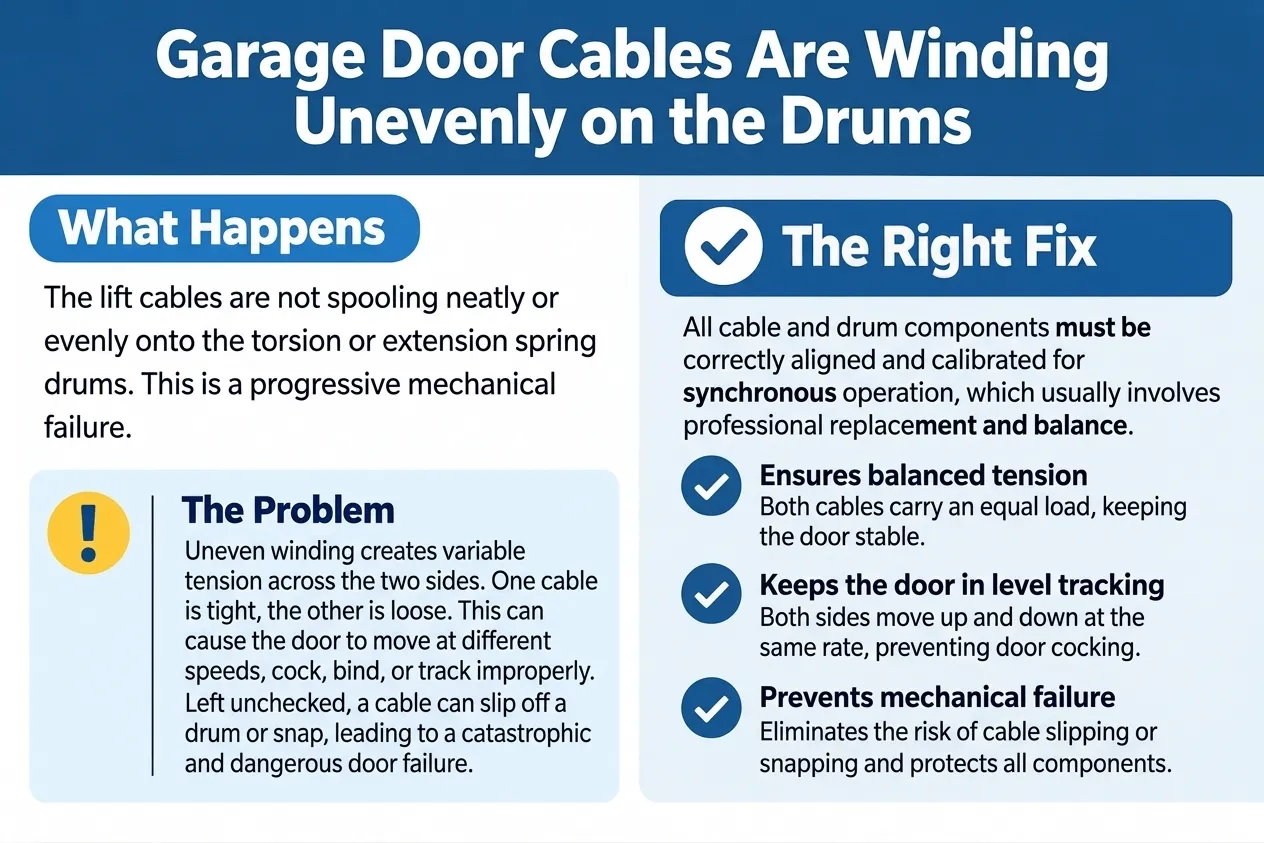
This is the first thing we look at on a crooked door, and it is the most common finding after recent spring work. Both drums have to be wound so the cables carry equal tension and both sides of the door lift together. If one drum was set even slightly differently during reassembly, one cable takes up before the other and that corner leads on every cycle.
The visual signature is specific: the door sits level when closed, then goes progressively more crooked as it rises.
Why uneven garage door cable winding makes the door sit crooked
The cable is what actually transmits the spring force to each side of the door. Wind one drum with a different number of wraps or at different tension, and one side receives more lift than the other from the moment the door starts moving. The trailing side then drags, its cable goes slack near the top of travel, and slack cable is how doors come out of the track and how corners drop. Cable and drum work happens under full spring tension and is not something to attempt, which is the same reason we covered the process in how to reattach a garage door cable as a technician job rather than a homeowner one.
Call a pro if: the door is level when closed but goes crooked as it opens, or you can see a cable that is loose at any point in the travel. Stop using the door.
2. The springs no longer match
On a two-spring door, both springs must deliver the same force. When one is replaced and the other is not, the new one is stronger, and that side of the door lifts ahead of the other from the first cycle onward. This is the single most common reason a door that ran level for a decade comes back from a repair sitting off.
Incorrect tension produces a milder version of the same thing even when both springs are new, if they were not wound to matched settings.
Why mismatched garage door springs cause the door to hang unevenly
Spring force drops as a spring ages and its coils fatigue. Pair a fresh spring against a tired one and you have two different amounts of lift applied at two different points on the same shaft. The door twists through its travel, the rollers on the trailing side load up against the track, and the cables see unequal tension for the entire cycle. The full list of ways this pattern repeats after service is in Why Does My Garage Door Keep Breaking After It Was Repaired? 10 Reasons a Quick Fix Doesn’t Hold, the master guide this post belongs to. If you want the background on spring wear, the early signs of a weak garage door spring covers what to watch for, and can a garage door work with a broken spring explains why running a door in that condition causes further damage.
Call a pro if: one spring was replaced and the other was not, or the door lifts noticeably faster on one side. Springs are under high tension and should never be adjusted by hand.
3. A hinge or a panel is damaged on one side
If the door was previously off track, hit by a vehicle, or forced at any point, a hinge can be bent and a panel edge can be deformed. A repair that got the door running again does not necessarily correct that damage, and damaged hardware on one side lets that side of the door sit differently from the other.
This is the cause that shows up most clearly when the door is closed. A door that sits level while moving but shows an uneven gap at the floor or along a jamb usually has a physical problem rather than a tension problem.
Why a damaged garage door hinge or panel makes the door look uneven
A hinge holds two panels in a fixed relationship, and it holds a roller in a fixed position relative to the track. Bend it and both of those change. The panel above it drops slightly, the roller no longer sits centered in the channel, and the door develops a permanent step along one edge. Damaged panels behave the same way and get worse, since the flex concentrates stress at the existing damage. When the damage is beyond what hardware can correct, garage door panel replacement is usually the honest answer rather than continued adjustment.
Call a pro if: you can see a bent or cracked hinge, a deformed panel edge, or a gap at the jamb that is visibly wider at the top than the bottom.
4. The vertical tracks are not set at matching spacing
Both vertical tracks must sit plumb and at the same distance from the door face. If one was reset during a repair without checking it against the other, the door is being held slightly further out on one side, which tilts it.
This one is easy to miss because the door still runs. Nothing binds, nothing grinds, and the door simply sits off by a consistent amount every time.
Why uneven garage door track spacing makes the door sit crooked
Track spacing determines how deep the rollers sit in their channels and where the door plane sits relative to the opening. Widen one side and that side of the door moves outward and downward slightly through the curve. The door now runs with a permanent twist, which loads the rollers on one side and starts the sequence described in Why Does My Garage Door Keep Coming Off Track After Being Fixed? 7 Causes. Alignment work like this is measured against the door and the opening together, which is why adjusting a garage door safely is not a matter of moving whatever looks wrong.
Call a pro if: the gap between the door and the track looks different on the left and right, or a track bracket has visibly moved.
5. The opener arm is pulling the door out of square
The opener connects to the top section through an arm, and that connection point has to be centered and square to the door. If the header bracket shifted, the arm was remounted off-center, or the rail is not aligned to the middle of the opening, the opener applies its pull to one side of the door rather than through its center.
An opener is strong enough to hold a door out of square through the entire cycle, which makes this cause easy to misread as a door problem.
Why a misaligned garage door opener arm twists the door
The opener pulls with a single point of force. When that point is off-center, everything downstream compensates: the top panel leads on one side, the rollers on the other side lag, and the whole door runs slightly rotated. It also means the opener is fighting the door on every cycle, which wears the drive components early. Settings are not the fix here, and adjusting a garage door opener safely explains why force and travel changes mask this kind of mechanical problem rather than solving it. Commercial openings run through our garage door opener repair team.
Call a pro if: the door is level when operated by hand but crooked when the opener runs it, or the top panel flexes visibly as the opener starts.
6. The opening or the floor is no longer level
The last cause is not the door at all. Headers and jambs move as a house settles. Garage slabs in this region crack and heave with the freeze and thaw cycle, and a slab that has lifted at one corner will leave a closed door showing a wedge of daylight even when the door itself is perfectly square.
We see this often enough here that it is worth checking before anyone starts adjusting hardware.
Why an unlevel garage floor makes a garage door look crooked
The door is a rigid rectangle closing against whatever the floor has become. If the slab has risen on one side, the bottom seal contacts there first, the door stops early, and the opposite corner sits high with a visible gap. Adjusting the door to match a heaved slab throws the rest of the assembly out of square and creates new problems. The correct approach is to confirm the floor and opening first and then set the door to the actual geometry, sometimes with seal work to close the remaining gap. Our guide to installing garage door weather stripping covers the sealing side, and how an aging garage door affects safety and performance covers what happens when a door runs out of square for a long time.
Call a pro if: daylight shows in a wedge shape along the floor when the door is closed, or the door contacts the slab on one side well before the other.
Where the unevenness shows compared to what it means
|
What you are seeing |
What it usually points to |
Is the door safe to operate |
|
Level when closed, crooked as it opens |
Uneven cable winding on the drums |
No. Stop using the door |
|
One side lifts faster through the whole cycle |
Mismatched or unequally tensioned springs |
No. Stop using the door |
|
Visible slack in a cable at any point |
Cable has lost tension or left its groove |
No. Leave the door closed |
|
Permanent step along one edge of the door |
Bent hinge or damaged panel |
Limit use until inspected |
|
Consistent tilt, door runs smoothly |
Track spacing set differently side to side |
Limit use until inspected |
|
Level by hand, crooked under the opener |
Opener arm or header bracket out of square |
Limit use until inspected |
|
Wedge of daylight along the floor when closed |
Slab or opening out of level |
Usually safe, have it assessed |
Two rules apply to every row. Do not try to push, pull or lever a crooked door back into alignment, because the tension that is holding it is the same tension that can drop it. And do not keep cycling the door to see whether it settles, because a door that is running out of square is damaging its own hardware on every pass.
What a correct alignment check involves
Rushed garage door work is a recognized issue across the industry rather than a local one. The trade association for the industry has been raising awareness about deceptive garage door service practices and keeps a public consumer resource page on garage door service scams. There is also manufacturer guidance on avoiding garage door repair scams describing what belongs in a legitimate service visit.
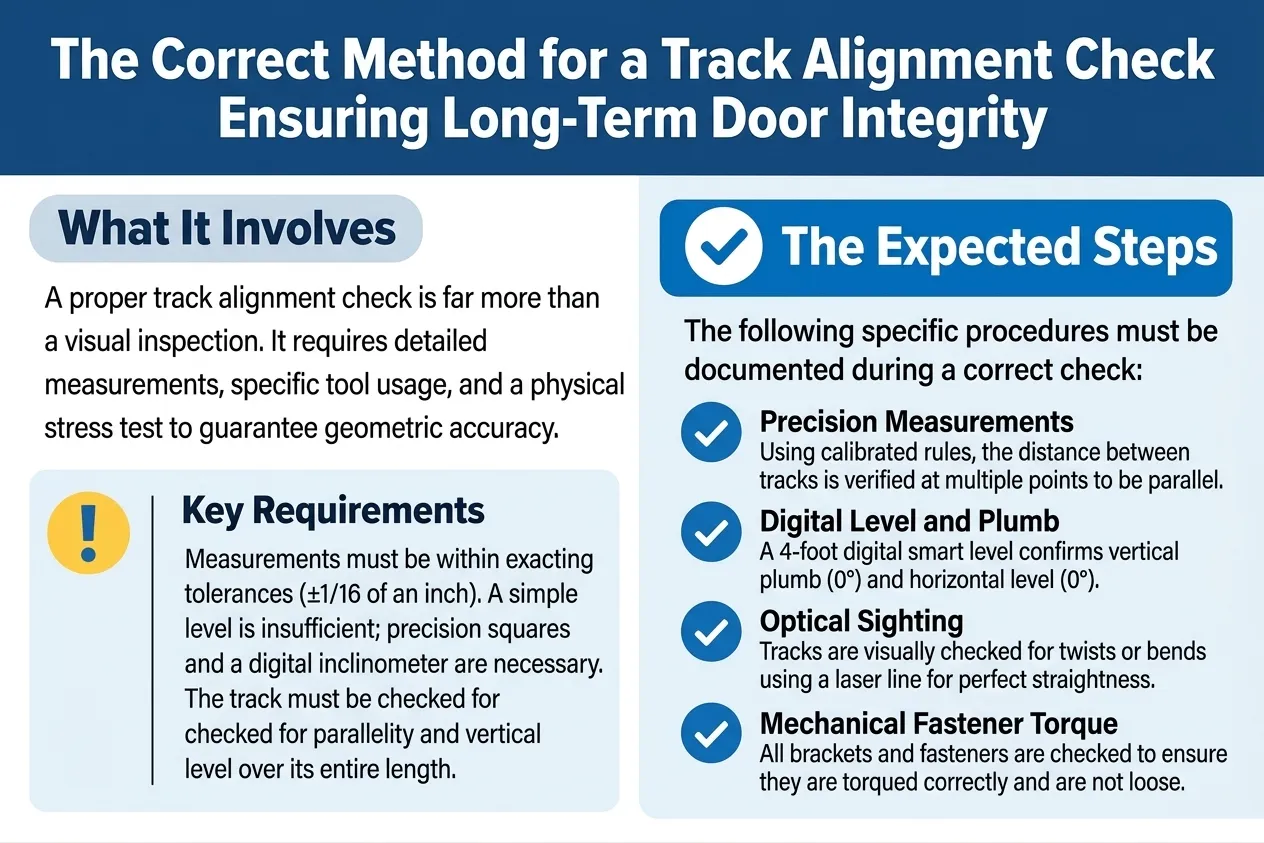
A real alignment check works in order: confirm the opening and floor, then the track spacing and plumb, then the balance with the opener disconnected, then cable tension and drum winding, then the hinges and panels, and only then the opener connection. Working out of that order means adjusting the door to compensate for something further up the chain, which is how a door ends up crooked in a new way after every visit. The component-by-component version of that inspection is in What Parts Get Overlooked in a Quick Garage Door Repair? 8 Components That Fail Next, and ongoing attention through garage door maintenance keeps most of these from developing at all.
The bottom line
A crooked garage door after a repair means the two sides are no longer being lifted evenly, and the reason is usually cable winding or springs that do not match. Damaged hardware, uneven track spacing, an off-center opener connection or a floor that has moved will produce the same appearance. None of it is cosmetic, because the low side is carrying load it was not designed for, and a door running out of square wears its own hardware faster with every cycle.
If your door has come back from a repair sitting uneven, Ascension Garage Door Service will check the alignment in the right order, identify which stage is actually out, and correct it rather than adjusting around it. We handle residential and commercial garage door repair and garage door service throughout Colorado Springs and El Paso County, along with garage door installation service when a door is too far out of square to be worth correcting. Schedule your inspection and get same-day attention on a door that is unsafe to use.