


A garage door that breaks again within weeks of a repair almost always means the repair addressed the broken part but not the reason it broke. Springs, cables, rollers and openers fail because of what the rest of the door is doing to them: an unbalanced door, a bent track, loose hardware, or a worn part sitting right next to the one that was replaced. Swap the failed component without correcting that, and the new component starts down the same path the day it goes in. The repair did not fail because the part was bad. It failed because the load that killed the first part is still there.
Key takeaways
- A repeat failure in the same spot points to an undiagnosed cause, not a faulty replacement part.
- Balance is the single most common thing skipped. A door the opener has to fight will keep destroying parts.
- Components wear as a set. Replacing one spring, one roller or one cable leaves the rest at the same age and mileage.
- An opener that was adjusted to push harder is masking a mechanical problem, not solving one.
- In Colorado Springs, temperature swings and dry air accelerate every one of these failures, so a marginal repair shows itself faster here than it would elsewhere.
- Springs, cables and anything under tension are not homeowner territory. A door that is binding, crooked or loud should be taken out of service until a technician looks at it.
1. The broken part was replaced but the cause was never found
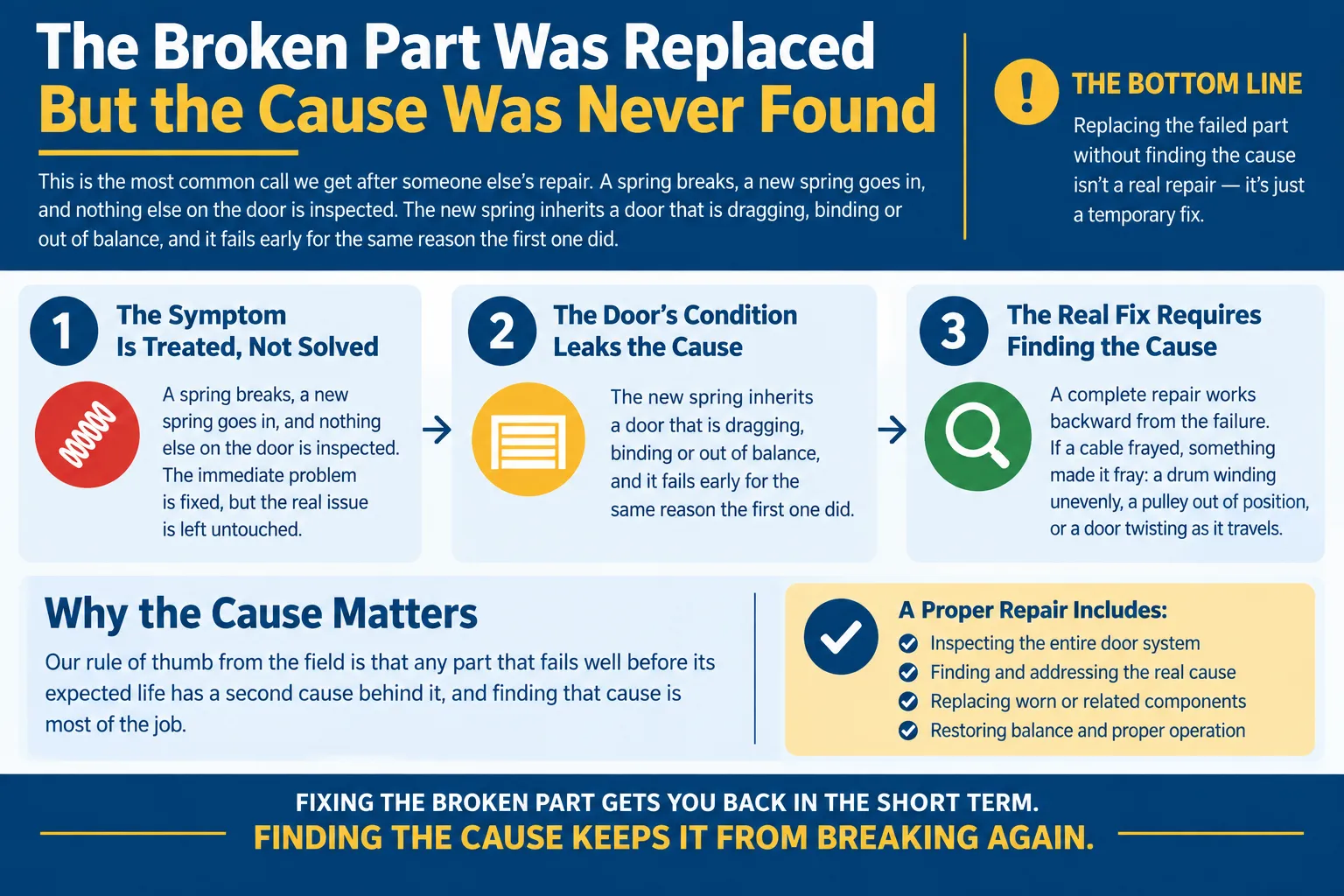
This is the most common call we get after someone else’s repair. A spring breaks, a new spring goes in, and nothing else on the door is inspected. The new spring inherits a door that is dragging, binding or out of balance, and it fails early for the same reason the first one did.
A complete repair works backward from the failure. If a cable frayed, something made it fray: a drum winding unevenly, a pulley out of position, a door twisting as it travels. Our rule of thumb from the field is that any part that fails well before its expected life has a second cause behind it, and finding that cause is most of the job.
Why a garage door keeps breaking when only the failed part is replaced
Every component on the door shares one load. Remove the failed link, leave the load path unchanged, and the next weakest link takes the damage instead. That is why a door can go from a broken spring to a snapped cable to a burned out opener across three separate service calls, each one treated as an unrelated problem. Our guide to what parts get overlooked in a quick garage door repair and the 8 components that fail next walks through the components that most often get skipped during a fast visit.
Call a pro if: the same part has failed twice in under two years, or a different part fails within weeks of a repair.
2. The door was never rebalanced after the repair
A balanced door holds its position anywhere in its travel. If it drifts down, slams, or springs upward when released, the spring tension does not match the weight of the door. Balance is the measurement that makes every other part last, and it is also the step most often skipped when a repair is rushed.
An unbalanced door does not announce itself. It runs, it opens, it closes. It just quietly transfers the mismatch into the opener gears, the cables and the rollers until one of them gives out.
Why an unbalanced garage door keeps damaging new parts
If the door is heavy on the springs, the opener carries weight it was never designed to lift, and the gear assembly wears out fast. If the door is light, it fights the closing cycle, the cables go slack on the drums, and they start to unwind out of their grooves. Checking balance requires disconnecting the opener and handling a door under spring tension, which is why it belongs to a technician and not to the homeowner.
Call a pro if: the door will not stay put when stopped partway, or it feels noticeably heavier than it used to.
3. Only one spring was replaced when both were the same age
On a two-spring door, both springs have taken the same number of cycles. When one breaks, the other is at the end of its service life too, even though it still looks fine. Replacing only the broken one is the fastest version of the repair, and it is why a second spring failure often follows the first by a matter of months.
There is a second problem beyond the timing. A new spring and an aged spring do not pull with equal force. The door goes up unevenly, one side leads, and the cables and rollers on the trailing side absorb the difference.
Why replacing one garage door spring leads to another break
Mismatched springs put the door into a permanent twist through its travel. That twist is what you are seeing when a door sits visibly off level after service, covered in why is my garage door crooked or uneven after a repair and the 6 causes behind it. If you want the background on why springs give out in the first place, our post on why garage door springs fail covers the wear pattern, and how long garage door springs typically last explains cycle life.
Call a pro if: one spring was replaced and the other was not, regardless of how the door currently runs.
4. Worn rollers were left in place
Rollers are small, inexpensive and easy to leave alone. They are also what the entire door rides on. Worn rollers with flat spots, seized bearings or excess play make the door jerk and bind through its travel, and every bit of that resistance goes straight into the springs, cables and opener.
Old rollers are also loud. If a door came back from service still grinding or rattling, the rollers are the first thing to suspect.
Why worn garage door rollers shorten the life of a new repair
A binding roller stops the door from tracking straight. The door pulls toward the side that is dragging, the cable on the opposite drum loses tension, and the assembly starts working itself out of alignment. What looks like a track problem weeks later often started as a roller problem on the day of the repair. Our post on what technicians check during a spring repair covers the surrounding components that should be inspected in the same visit.
Call a pro if: the door still grinds, shudders or squeals after a repair, or you can see a roller that is not spinning as the door moves.
5. Loose hardware was never retightened
A garage door goes through thousands of cycles a year, and every one of them puts vibration through the hinges, brackets, track fasteners and opener mounts. Hardware backs out over time. When a technician has the door apart for any repair, that hardware should be checked and retightened as a matter of course.
Loose hardware is the quietest item on this list and one of the most destructive. Nothing looks wrong until a hinge has elongated its holes or a bracket has shifted.
Why loose garage door hardware causes repeat failures
A loose hinge lets a panel flex independently of the one above it. That flex changes the geometry of the door as it curves through the radius of the track, which pulls a roller toward the edge of its guide. Give it enough cycles and the door starts leaving the track entirely. That progression is the subject of why does my garage door keep coming off track after being fixed and the 7 causes behind it, and if you want the general picture of what unaddressed wear turns into, we covered it in the hidden risks of ignoring garage door wear and damage.
Call a pro if: you can see a visible gap between a hinge and the panel, or a bracket that has shifted out of its original position.
6. Old cables were reused, or the drums were not wound evenly
Cables are the most safety-critical part of a garage door after the springs. They also show wear long before they break: fraying at the bottom bracket, kinks, rust spots, strands lifting away from the bundle. A repair that replaces a spring but reuses aged cables is leaving the next failure in place.
Winding is just as important as the cable itself. Both drums have to be set so the cables carry equal tension and seat properly in their grooves.
Why reused garage door cables fail soon after a spring repair
A new spring changes the forces the cables see. Aged cable that was holding up under the old tension can start unwinding, jumping the drum or fraying under the new one. Uneven drum winding produces the same result faster, since one side of the door lifts ahead of the other and the trailing cable goes slack at the top of travel. Slack cable is how doors come off track and how they fall. We covered the timing in when to replace garage door cables and the consequences in what happens if you don’t replace garage door cables.
Call a pro if: you can see a loose or hanging cable, any fraying, or the door lifting unevenly. Stop using the door until it is inspected.
7. A bent track section was straightened instead of replaced
Track damage from a vehicle bump, a falling object or a previous off-track event leaves a section that no longer matches the factory profile. Straightening it gets the door running again the same day. It does not restore the dimension the roller needs, and the door will work its way back out of that section over the following weeks.
Track also has to stay parallel and plumb along its whole run, with consistent spacing from the door face. A bent section that has been pulled back into rough shape almost never holds that spacing.
Why a straightened garage door track keeps failing
Rollers ride on a narrow surface with very little margin. A section that is slightly wide lets the roller wander and eventually come out. A section that is slightly tight forces the roller to climb, which stresses the hinge it is mounted to and pushes the panel out of line. You end up chasing a moving problem: the door catches in a different place each time because nothing in that section is holding a consistent dimension. If you need the general repair picture for a door that has left its track, our post on how to fix a garage door that is off track covers it.
Call a pro if: you can see a dent, twist or splice in the track, or the door catches at the same point every cycle.
8. The opener was adjusted to push harder instead of fixing the door
When a door drags, the fastest way to make it close is to increase the opener’s force setting. It works, in the sense that the door moves. It also removes the only warning system you had. Force settings exist so the opener stops when it meets resistance, which is what protects anything under the door.
Travel limits get moved for the same reason, so the door will seat against the floor despite a mechanical issue keeping it from getting there naturally.
Why turning up a garage door opener’s force masks a bigger problem
The opener is now pushing a door that was already fighting something. The gear assembly wears through faster, the door hits the floor harder than it should, and the reversal safety that should catch an obstruction has been dialed past the point where it can. Meanwhile the original drag is untouched and getting worse. If your opener has been struggling since a repair, our guide to adjusting a garage door opener explains what those settings actually control, and commercial operators have their own service path through our garage door opener repair team.
Call a pro if: the opener strains, the door bounces at the floor, or the door fails to reverse when it meets an obstruction. That last one is a safety failure and the door should be taken out of service.
9. The safety sensors were nudged into alignment rather than remounted
Sensors that keep losing alignment are rarely bad sensors. They are usually sensors on a loose bracket, a bent mount, or a wire that has been pinched or stapled through. Tapping them back into line clears the fault for a day or two and the door starts reversing again by the end of the week.
Intermittent sensor faults are one of our most common calls, and the intermittent part is the clue. A genuinely failed sensor stays failed.
Why garage door sensors keep losing alignment after a repair
Every cycle sends vibration through the track the sensors are mounted to. A bracket that is not solid moves a fraction each time, which is enough to break the beam. The same goes for wiring: a conductor that is nearly severed makes contact when the weather is cool and opens up when it is warm, which is why these faults follow the time of day. We broke the fault codes down in garage door sensor light colors and the intermittent pattern specifically in what causes inconsistent garage door sensor lights.
Call a pro if: the sensors need realigning more than once, or the door reverses with nothing in the opening.
10. The door and the opening were never checked as one system
The last one covers everything the door is attached to. Headers and jambs move as a house settles. Garage floors in this region heave and crack with the freeze and thaw cycle. Weather seal hardens, and the bottom of the door starts catching on a slab that is no longer flat. None of that is a door part, and all of it shortens the life of a repair.
A door that has been repaired three times in a year usually has a structural or environmental cause nobody has looked at yet.
Why a garage door keeps breaking when the whole system is not inspected
Colorado Springs is hard on these assemblies. Wide daily temperature swings expand and contract steel, dry air strips lubricant faster, and the freeze and thaw cycle moves slabs and jambs. A door that was set up correctly two years ago can be out of square today through no fault of the door. That is the difference between a repair and a service inspection, and it is why we treat the opening as part of the job on residential and garage door service calls alike. For the failures we see most often in this area, we keep a running list in common garage door problems in Colorado Springs.
Call a pro if: the door contacts the floor unevenly, daylight shows through one side when closed, or the door has needed repair more than twice in a year.
What a lasting repair covers compared to a quick fix
|
What gets done |
Quick fix |
Repair that holds |
|
Failed part |
Replaced |
Replaced |
|
Cause of the failure |
Not investigated |
Diagnosed and corrected |
|
Door balance |
Not measured |
Measured and set with the opener disconnected |
|
Matched components (springs, cables, rollers) |
Only the broken one |
Evaluated as a set and replaced together when they share the same age |
|
Hardware and fasteners |
Left as found |
Inspected and retightened |
|
Track condition |
Adjusted or straightened |
Measured for alignment, damaged sections replaced |
|
Opener force and travel limits |
Increased to compensate |
Set correctly after the door moves freely |
|
Safety reversal test |
Often skipped |
Verified before leaving |
|
Opening, floor and weather seal |
Not part of the call |
Inspected as part of the system |
|
Typical result |
Runs today, fails again within weeks |
Runs for its expected service life |
What a thorough repair should look like
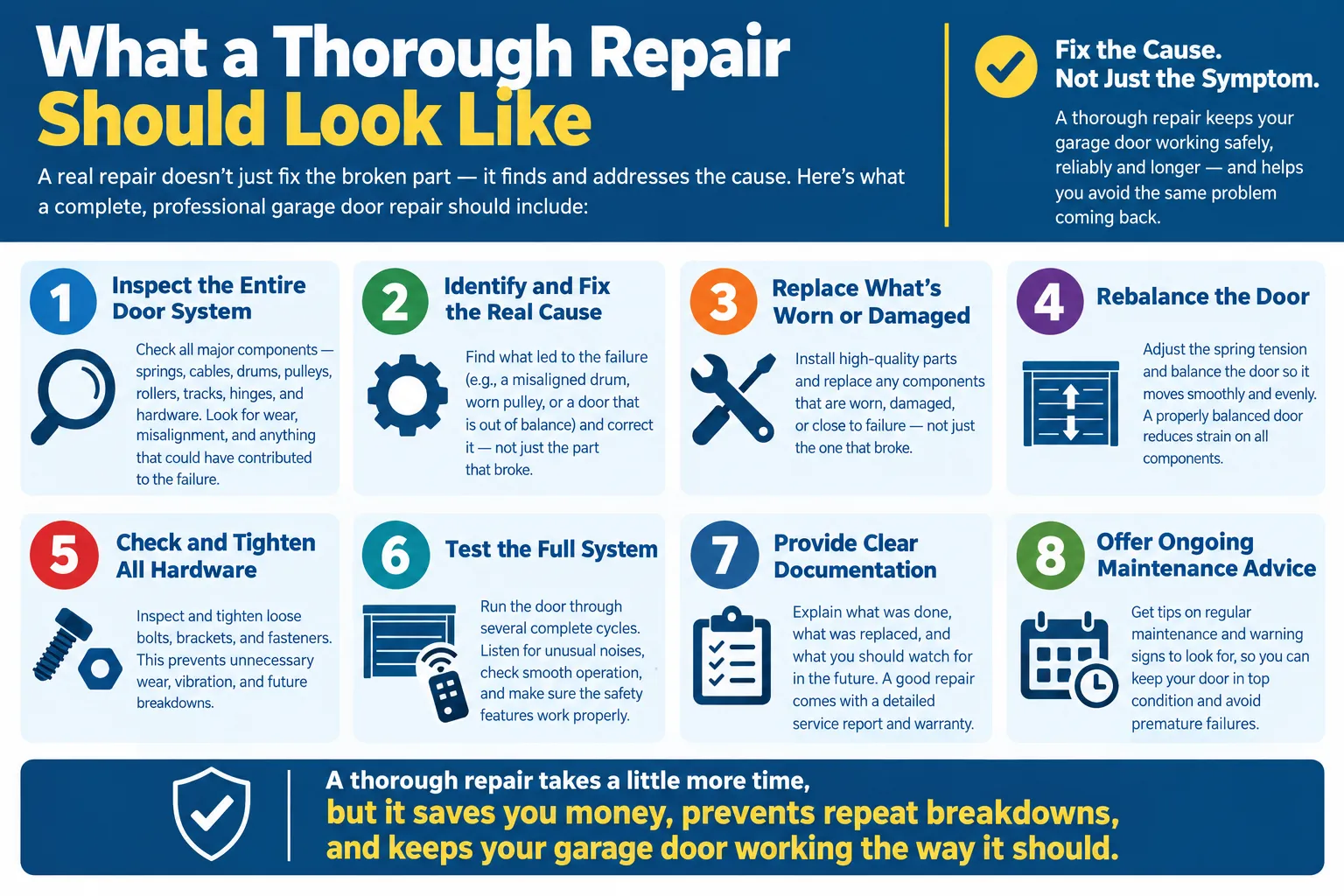
Industry groups have published plenty on this, because rushed and questionable garage door work is a known problem nationally, not just here. The trade association for the industry has been raising awareness about deceptive garage door service practices, and maintains a public consumer resource page on garage door service scams. There is also useful manufacturer guidance on avoiding garage door repair scams that covers what a legitimate service visit includes.
The common thread across all three: a real repair is diagnostic before it is transactional. Someone should be looking at the whole door, explaining what they found, and telling you which parts are near the end of their life even when those parts are not what you called about.
The bottom line
A garage door that keeps breaking after it was repaired is not unlucky. It is telling you that something upstream of the broken part was never corrected, and every new component you install is going to meet the same conditions that destroyed the last one. The cycle stops when someone diagnoses the door as a system: balance, springs, cables, rollers, hardware, track, opener settings and the opening itself.
If your door has failed more than once, Ascension Garage Door Service will inspect the entire assembly, find what is actually driving the failures, and tell you honestly what needs to be corrected and what is still serviceable. We handle residential and commercial work across Colorado Springs and El Paso County, including garage door repair and new garage door installation service when a door has reached the end of its life. Schedule your inspection and get same-day service on doors that are unsafe to use.