


A garage door that comes off track a second or third time is almost never a track problem on its own. The track is where the failure shows up, not where it starts. In nearly every repeat case we see, the door left the track because a roller, cable, hinge or balance issue pushed it out, and the repair put the door back in the track without correcting whatever pushed it. Once the door is running again it looks solved, so the real cause stays in place and keeps working the door toward the edge of the track until it jumps again. A door that has come off track more than once should be treated as an unsafe door and taken out of service until the whole assembly has been inspected.
Key takeaways
- Coming off track twice means the original cause was never found. A correctly repaired door does not do this.
- Rollers and cables are the two most common drivers. Both are routinely left alone when a door is simply reseated.
- A track section that was straightened rather than replaced will not hold the dimension a roller needs.
- Slack cable is the most dangerous item on this list. A door with a loose cable can come down.
- Colorado Springs conditions accelerate this, because temperature swings and dry air move hardware and strip lubricant faster.
- Do not attempt to lift, force or reseat a door that has come off track. It is heavy, it is under tension, and it can fall.
1. A bent track section was straightened instead of replaced
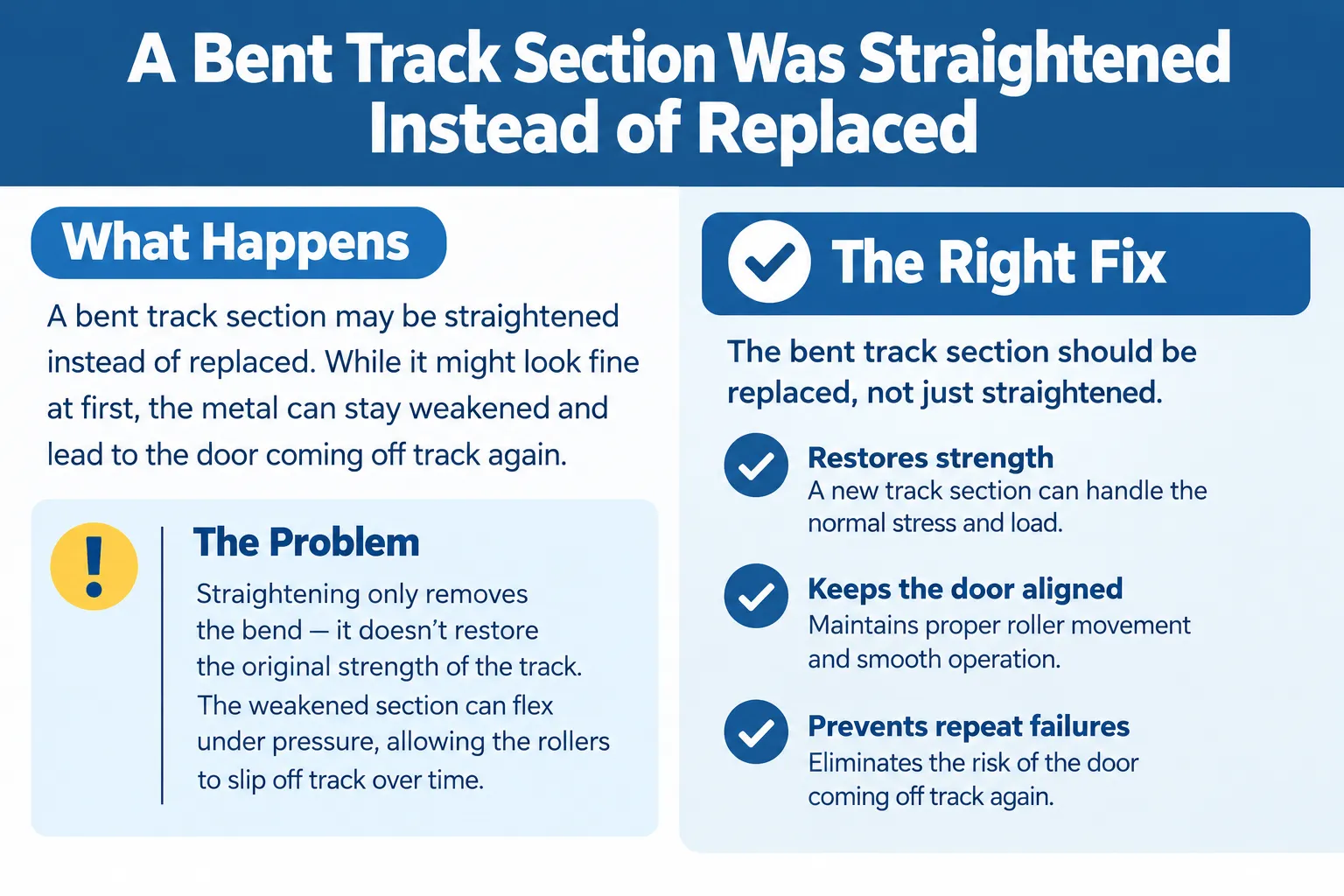
This is the most common cause behind a repeat off-track door. When a door jumps out, it usually deforms the track on the way. Pulling that section roughly back into shape gets the door running the same day, but the section no longer matches its original profile, and the roller passing through it has almost no margin for error.
The door will run through that section fine for a while. As hardware settles and the door cycles, the roller finds the weak spot again.
Why a straightened garage door track keeps letting the door jump out
Roller travel depends on consistent spacing between the track and the door face along the entire run. A repaired section that is even slightly wide lets the roller wander toward the open edge of the track. A section that is slightly tight forces the roller to climb, which loads the hinge and pushes the panel out of line. Either way the door is being steered out of its own track by the part that was supposed to guide it. For the general repair picture on a door that has already left its track, see how to fix a garage door that is off track.
Call a pro if: you can see a dent, kink, twist or splice anywhere in the vertical or horizontal track, or the door catches at the same point every cycle.
2. Worn rollers were left in place
Rollers are the parts that actually hold the door in the track, and they are the most common thing skipped when a door is reseated. A roller with a flat spot, a seized bearing or excessive play in its stem does not sit properly in the track channel. It drags, it tips, and it walks toward the edge.
Rollers also wear as a set. Replacing the two that came out while leaving the other eight at the same mileage is how a door comes off in a different spot next time.
Why worn garage door rollers cause the door to come off track again
A roller that will not spin stops rolling and starts sliding. Sliding produces side load that the roller stem was never meant to carry, so the stem flexes, the roller tips in its bracket, and the wheel rides up the edge of the channel. The moment the door hits the curve where the vertical track meets the horizontal, that tipped roller has nothing holding it in. Our garage door roller repair work covers replacing them as a matched set for this reason, and worn rollers are one item on the broader list in What Parts Get Overlooked in a Quick Garage Door Repair? 8 Components That Fail Next.
Call a pro if: the door grinds, shudders or rattles through its travel, or you can see a roller that is not turning as the door moves.
3. A cable is slack, frayed or winding unevenly on the drum
Cables hold the door in tension against the springs and keep both sides lifting together. When one cable goes slack, the door loses the force holding that side down into the track, and the panel on that side can lift free and come out. This is the fastest and the most dangerous route to a repeat off-track door.
Cable problems rarely announce themselves before they cause damage. Fraying at the bottom bracket, a strand lifting out of the bundle, or a cable that has jumped its groove on the drum can all be present on a door that still runs.
Why a slack garage door cable pulls the door off track
The two drums have to be wound so both cables carry equal tension through the full travel. If one drum is wound slightly off, its cable goes loose near the top of travel, and the door hangs on the other side. Worse, a loose cable can unwrap from the drum entirely and let that corner of the door drop. Cables are under the same tension as the springs and are not something to touch. We covered the timing question in when to replace garage door cables and why the job belongs to a technician in is it safe to replace garage door cables yourself.
Call a pro if: you can see any loose, hanging or frayed cable, or one side of the door leads the other on the way up. Stop using the door.
4. Track brackets and fasteners loosened and the spacing drifted
The track is held to the wall and ceiling by brackets, and those brackets are set at a specific distance from the door face. Thousands of cycles of vibration back fasteners out. When a bracket shifts even slightly, the spacing between the track and the door changes, and the roller stem starts sitting at an angle.
This is a quiet failure. Nothing looks wrong from the driveway, and a technician who is only reseating the door has no reason to check it.
Why loose garage door track brackets let the door come off repeatedly
Roller stems have very little depth in the track channel. Move a bracket a fraction of an inch away from the door and the roller has less of itself in the channel to hold onto. Add the vibration of normal operation and the door works itself out at the weakest bracket. This is also why a door can come off in a different place each time, which homeowners often read as bad luck when it is actually progressive loosening along the run. Routine attention prevents most of it, and our post on the best garage door maintenance practices covers what should be checked and how often.
Call a pro if: you can see a bracket that has pulled away from the wall, a fastener backing out, or a gap between the track and the door that is wider in one place than another.
5. Hinges or panel edges are damaged and the door is flexing
Rollers mount to hinges, and hinges mount to panels. If a hinge is bent, cracked, or has elongated the holes it is fastened through, the roller attached to it is no longer held in a fixed position. The panel edge itself can also be damaged from a previous off-track event, which produces the same result.
Damaged hinges are common after any off-track incident, because the forces that pull a door out of its track go straight through the hinges on the way.
Why damaged garage door hinges cause the door to leave the track
A door has to stay rigid as it curves through the radius. If one hinge allows a panel to flex independently of the one above it, the geometry changes right at the point where the track curves, which is where most doors come out. That is also the point where the least amount of roller is engaged in the channel. Damage like this compounds, and the broader consequences are covered in the hidden risks of ignoring garage door wear and damage.
Call a pro if: you can see a bent or cracked hinge, a hinge with visible movement, or a panel edge that is deformed.
6. The door is out of balance and the opener is dragging it through
Balance is the relationship between spring tension and the weight of the door. A balanced door holds its position anywhere in its travel. When balance is off, the opener has to force the door, and forcing a door means side loads that the rollers and track were never designed to absorb.
Balance is also the step most often skipped after a repair, because it requires disconnecting the opener and handling the door under spring tension.
Why an unbalanced garage door keeps coming off track
If the springs are under-tensioned, the opener drags a heavy door upward, and the top panel is pulled forward against the curve in the track while the rest of the door lags. If the springs are over-tensioned, the door goes up faster than the opener commands and slams into the top of travel. Both put the door out of alignment during the part of the cycle where it is least secure in the track. The related symptom of a door that sits visibly off level is covered in Why Is My Garage Door Crooked or Uneven After a Repair? 6 Causes, and the full range of repeat-failure causes is in Why Does My Garage Door Keep Breaking After It Was Repaired? 10 Reasons a Quick Fix Doesn’t Hold, the master guide this post belongs to.
Call a pro if: the door will not stay put when stopped partway, it feels heavier than it used to, or the opener strains through part of the travel. Balance work involves parts under high tension and is not homeowner territory.
7. The opening itself is out of square
The last cause sits outside the door. Headers and jambs move as a house settles. Garage floors in this region crack and heave with the freeze and thaw cycle. A vehicle impact can shift a jamb without leaving obvious damage. When the opening moves, the track mounted to it moves with it, and the door is now running in a path that no longer matches the door.
This is the cause behind most doors that have come off track three or more times despite everything on the door being replaced.
Why an out-of-square garage door opening causes repeat off-track failures
Tracks have to be plumb, parallel to each other, and square to the door. If the opening has shifted, a technician can align the track perfectly to the wall and still have it out of square relative to the door. The door will then run tight on one side and loose on the other through every cycle, and the loose side is where it eventually comes out. Correcting this means shimming or remounting to the actual geometry of the opening rather than to the framing. For the failures we see most often in this area, we keep a running list in common garage door problems in Colorado Springs, and when a door has been out of square long enough to damage its panels, the top warning signs you need a garage door replacement covers where that line is.
Call a pro if: the door contacts the floor unevenly, daylight shows along one side when closed, or the gap between the door and the jamb is visibly different from top to bottom.
What to do when a garage door has come off track
|
What you are seeing |
What it usually means |
Is the door safe to operate |
|
Door is out of the track, still hanging |
Roller, cable or hinge failure at that point |
No. Leave it closed and do not run the opener |
|
Loose or hanging cable |
Cable has left the drum or failed |
No. Stop using the door immediately |
|
Door runs but grinds or shudders |
Worn rollers or binding through a damaged track section |
Limit use until inspected |
|
Door catches at the same point each cycle |
Damaged or misaligned track section |
Limit use until inspected |
|
Door has come off track more than once |
An underlying cause has never been corrected |
No. Take it out of service and have the full assembly inspected |
|
Door runs quietly and holds its position when stopped |
Assembly is aligned and balanced |
Yes, with normal annual service |
Two rules cover every row. Do not try to lift, force or reseat a door that is out of its track, because the door is heavy, the springs are under tension, and it can come down. And do not keep running the opener to see whether it works itself out, because every cycle adds damage to the track and hinges.
What a proper track repair should include
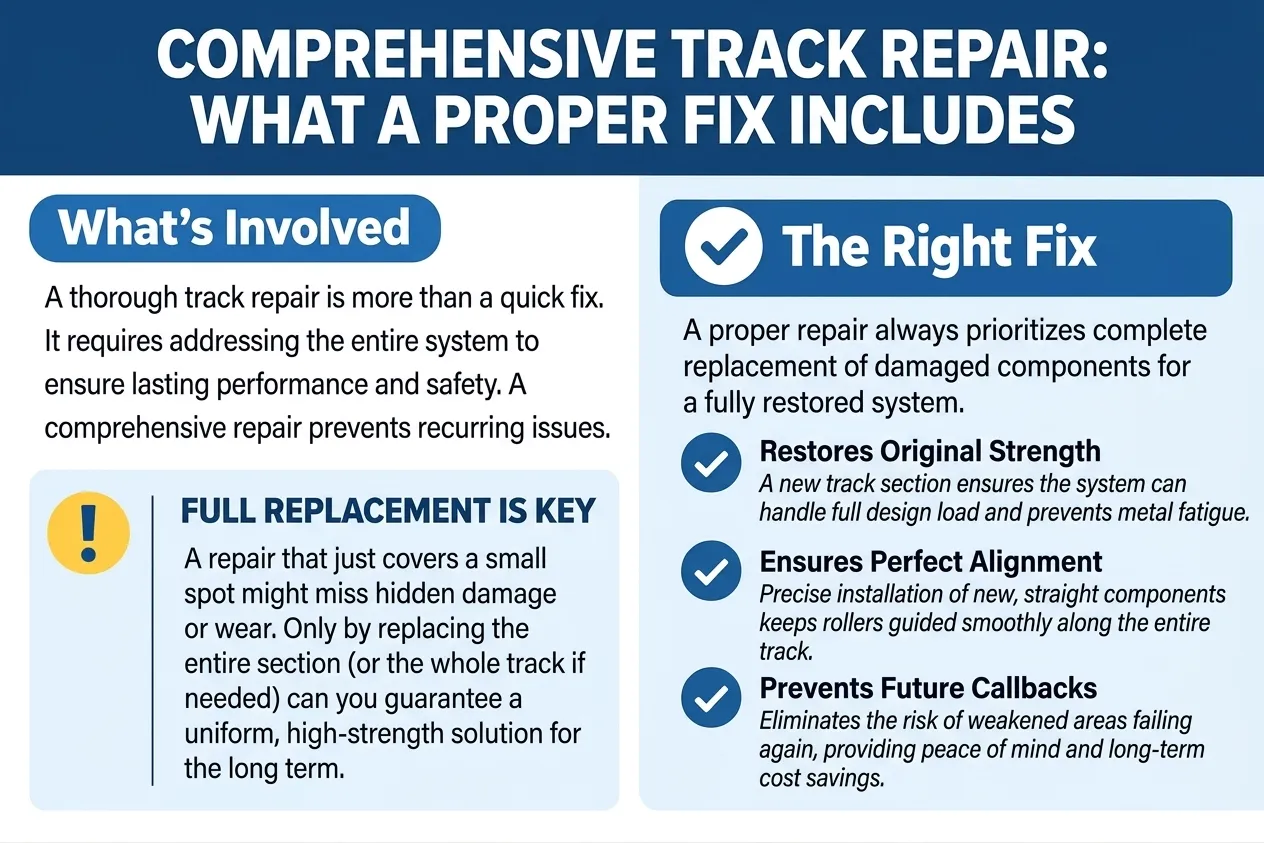
Rushed garage door work is a recognized problem across the industry, not just a local one. The trade association for the industry has been raising awareness about deceptive garage door service practices and maintains a public consumer resource page on garage door service scams. There is also manufacturer guidance on avoiding garage door repair scams that describes what a legitimate service visit covers.
The pattern across all three is the same. A visit that ends with the door back in the track and nothing else inspected has not diagnosed anything. A proper repair looks at the rollers, cables, drums, hinges, brackets, track condition, balance and the squareness of the opening, then explains what was found and what caused it.
The bottom line
A garage door that keeps coming off track is telling you that something is steering it out, and that something has survived every repair so far. Worn rollers, a slack cable, a straightened track section, loose brackets, damaged hinges, poor balance or an opening that has shifted will each do it, and several of them often appear together on the same door. Until the cause is identified, the door will keep leaving the track, and each time it does it damages more of the assembly.
If your door has come off track more than once, Ascension Garage Door Service will inspect the entire system, identify what keeps pushing the door out, and correct it rather than just reseating the door. We handle residential and commercial garage door repair across Colorado Springs and El Paso County, along with garage door service, garage door opener repair and garage door installation service when a door has reached the end of its life. Schedule your inspection and get same-day attention on a door that is unsafe to use.