


To open a stuck garage door manually, close the door fully if you can, unplug the opener, confirm the spring is not broken, clear the opening, release any manual slide locks, pull the red emergency release handle straight down, then lift the door by hand from the bottom section with both hands. The whole process takes about two minutes. The one step people skip is checking the spring, and it is the step that matters most: if the spring is broken, the door is unsupported weight and pulling the release can drop it. Read the safety checks before you touch the cord.
Key takeaways
- The red cord disconnects the door from the opener. It does not make the door lighter.
- Never pull the release while the door is up or partway open unless the door is supported. A door with a failed spring will come down fast.
- If one side of the door hangs lower than the other, do not use the release at all. That is a cable failure.
- Unplug the opener first. If power returns while you are working, the opener can start a cycle.
- A properly balanced door should feel like lifting eight to ten pounds. If it feels like lifting a hundred, stop and call someone.
Before you pull the red cord: 4 safety checks
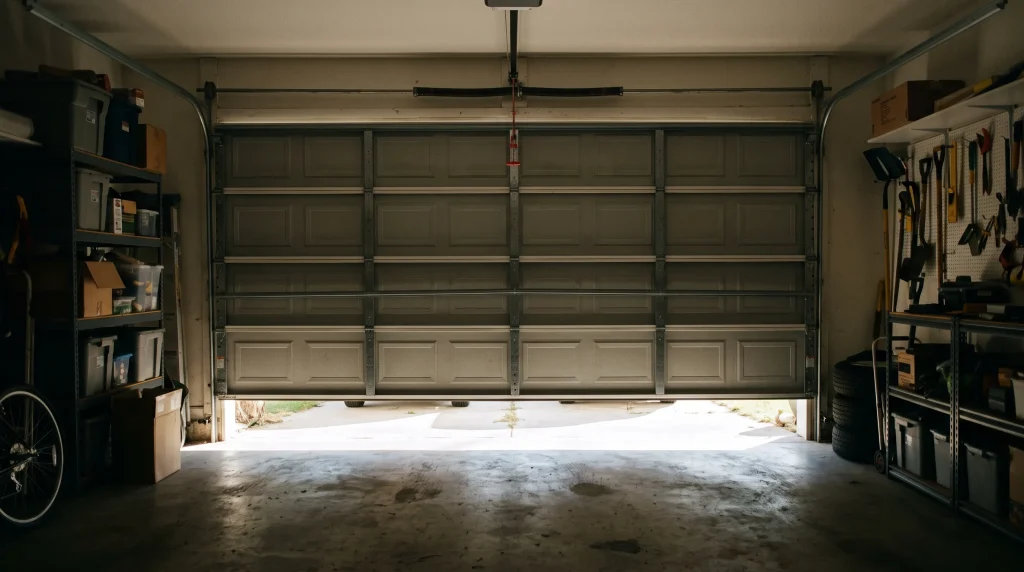
Run these four checks first. They take thirty seconds and they are the difference between a routine manual open and an injury.
- Is the door fully closed? A closed door is resting on the floor and cannot fall. That is the safest position to release from.
- Is there a gap in the torsion spring above the door? A two-inch to three-inch gap means the spring is broken and the door is unsupported.
- Is the door sitting level? A crooked door means a cable has failed and the door is unstable.
- Is anyone or anything under the door? Clear vehicles, pets, and children out of the opening and keep them out.
Why the emergency release is dangerous on a door that is already up
The industry safety guidance from DASMA, the trade association that writes the standards for these systems, is direct on this point: know how to use the release before you need it, and understand that spring systems are not homeowner-serviceable. When the door is up, the springs are what hold it there. Disconnect the opener from a door with a failed spring and there is nothing left carrying the load. If you are not certain why your door is stuck in the first place, work through Why Is My Garage Door Stuck? 10 Common Causes (and How to Fix Them) before you touch anything.
Step 1: Close the door fully if you safely can
What to do: If the door is open or partway open, get it fully closed before releasing anything. Use the opener if it still responds. If the door is stuck partway and will not come down, stop and skip to the section on when not to use the release.
Why it matters: A closed door is at rest on the concrete. Nothing can drop. Every other position puts the full weight of the door on components you are about to disconnect.
How to release a garage door that is stuck partway open
If the door is suspended and will not move in either direction, it needs to be supported before anything is disconnected. That means a prop under each side near the edges, not a hand in the middle. Why Is My Garage Door Stuck Halfway? 7 Causes (and How to Get It Down Safely) walks the full procedure for lowering a suspended door without getting under it.
Step 2: Cut power to the opener
What to do: Unplug the opener from the ceiling outlet. If you cannot reach the plug, switch off the breaker for the garage.
Why it matters: Two reasons. During an outage, power can return without warning and the opener will try to run a cycle. And if the unit has a battery backup, unplugging the wall power does not stop it, so switch the backup off as well.
Why you should unplug the opener before using the manual release
Battery backup units are the one people forget. They exist specifically so the door still works during an outage, which means the opener is live even when the house is dark. If your backup has stopped holding a charge, our guide on how to replace a garage door opener battery covers the swap, and a healthy backup often means you never need the release cord at all.
Step 3: Check the spring before you touch the cord
What to do: Look at the spring mounted on the steel shaft above the door opening. Use a flashlight. You are looking for a clean gap of roughly two to three inches in the coil.
If you see a gap: Stop here. Do not pull the release. Do not try to lift the door. Call a technician.
If the spring looks intact: Continue to step 4.
How to tell if a garage door spring is broken before releasing the opener
A broken spring is the most common reason a door is stuck, and it is the one condition that makes the emergency release genuinely hazardous. Some doors use extension springs running along the horizontal tracks instead, and a break there shows as a spring hanging slack or in two pieces. Our article on whether a garage door can work with a broken spring explains what the opener is actually doing when it tries, and why a few attempts can cost you the motor as well as the spring.
Step 4: Clear the opening and the floor
What to do: Move vehicles, bikes, trash bins, and hoses out of the door’s path. Sweep or scrape the threshold clear of ice, packed snow, grit, and salt buildup.
Why it matters: Once the door is on manual it moves freely and quickly. Anything in the path becomes a hazard, and anything under the seal will stop the door dead partway through your lift.
Why ice and road salt at the threshold stop a manual lift
Colorado Springs winters put a lot of magnesium chloride and sand on the roads, and your tires bring it into the garage where it dries into a hard crust at the door line. If you treat your own driveway, it is worth knowing which products leave the heaviest residue, and Michigan State University Extension’s comparison of winter deicers lays out the trade-offs. A threshold swept clean takes ten seconds and prevents the most frustrating version of this job.
Step 5: Release any manual slide locks
What to do: Check both sides of the door for a sliding steel bolt that engages into a slot in the vertical track. Some doors have a single lock with a rope pull or a handle. Retract every one of them.
Why it matters: A manual lock physically pins the door to the track. No amount of lifting will move it, and forcing an opener against one causes real damage.
What happens when you force a garage door against an engaged lock
The bolt holds, the opener pulls, and something bends. Usually it is the track at the lock slot or the bracket where the arm attaches to the top section. That is how a locked door becomes an off-track door, and our guide on how to fix a garage door that is off track covers why that repair is more involved than it looks.
Step 6: Pull the emergency release handle
What to do: Find the red handle on a cord hanging from the trolley on the rail, usually near the center of the garage about six feet up. With the door closed, pull it straight down until you hear or feel the lever click into the released position.
On some models: Pulling down and slightly back toward the door locks the lever in the disengaged position so the trolley stays free. Check your manual, since this varies by brand.
What should happen: The door is now disconnected from the opener and moves independently.
What the red cord on a garage door opener actually does
The cord releases the trolley, which is the connection between the motor’s chain or belt and the arm attached to your door. Nothing else changes. The door still weighs what it weighed. This is also why a motor that runs while the door sits still means the trolley is already disengaged, a scenario covered in our post on a garage door opener that clicks but will not open.
Step 7: Lift the door by hand
What to do: Stand to one side of the opening, not underneath. Place both hands on the bottom section, on the flat face of the panel and never in the seams between sections. Lift with your legs in one smooth motion.
What a healthy door feels like: Eight to ten pounds of effort. It should glide, and it should stay put wherever you stop it.
Stop immediately if: The door feels extremely heavy, will not budge, binds, or drops when you let go.
Why a garage door that will not lift by hand is telling you something
A balanced door is easy to lift by design, so difficulty is diagnostic rather than a matter of strength. Extreme weight points at a spring. Binding at one spot points at a track or roller. A door that will not break free at the base on a cold morning is usually bonded to the concrete by ice, and Why Is My Garage Door Frozen Shut? 6 Winter Causes and Safe Fixes covers how to break that bond without tearing the seal.
Step 8: Secure the door before you walk away
What to do: If the door is open and you need it to stay open, clamp a pair of locking pliers onto the vertical track just below a roller on each side. If it is closed, engage the manual slide locks.
Why it matters: A door on manual has no opener holding position. If the spring is even slightly weak, an open door can drift down on its own.
How to hold a garage door open safely without the opener
Locking pliers on the track are the standard field method and they cost a few dollars. Do not prop a door open with a ladder, a broom, or a length of lumber under the center. A door coming down onto a prop concentrates the entire load at one point and cracks the panel.
How to re-engage the opener afterward
- Close the door fully by hand.
- Pull the release cord toward the door, or straight down again depending on model, to reset the lever to its engaged position.
- Press the wall button. The trolley travels along the rail until it clicks back onto the carriage.
- Run one complete open and close cycle and watch for smooth travel.
Why the trolley will not always reconnect on the first try
The trolley has to meet the carriage at the exact point where the door was when you disengaged it. If it passes without catching, move the door by hand to a different position and run the opener again. After a power outage there is often a second task waiting: smart openers frequently lose their network connection, and our walkthrough on resetting a myQ garage door opener’s WiFi covers getting the app talking to the unit again.
What if the door will not lift even after you release it?
The release has done its job and the door is still stuck. That narrows things considerably, and none of the remaining causes are homeowner repairs.
- It is extremely heavy: broken or unwound spring.
- It sits crooked or one side is low: failed cable.
- It binds at one specific height: bent track, flat roller, or a damaged section.
- It will not break free at the floor: ice bond or a manual lock you missed.
Why a released door that still will not move means a mechanical failure
Once the opener is out of the equation, everything left is the door itself. A crooked door in particular is the one that should stop you cold, because a cable failure leaves the load carried unevenly on hardware that was not designed for it. Correct garage door drum and cable service means rewinding the drum and matching both cable lengths, not simply threading a new cable through.
When you should not use the emergency release at all
Skip the release and call a technician if any of these are true:
- The torsion spring has a visible gap, or an extension spring hangs slack.
- The door is suspended partway and unsupported.
- One side of the door is visibly lower than the other.
- A cable is frayed, slack, or off its drum.
- The door has come off its track.
- You cannot see the spring clearly enough to judge.
Why pulling the release on a broken spring is the most dangerous mistake
With the spring intact, the opener and the springs share the load. With the spring broken, the opener’s drive system is often the only thing holding several hundred pounds in place. Disconnect it and the door can drop the full height of the opening. This is why broken garage door spring repair is technician work in every case, and why we would rather you called before touching the cord than after.
Check for damage before you reconnect
Before you put the door back on the opener, take one minute to look it over, especially if it was forced before you reached for the release.
- Check the bottom section for a bow, a crease, or a bracket pulling away from the panel.
- Check that the bottom seal is fully seated in its retainer.
- Look for plastic shavings or grey dust on top of the opener, which indicates a stripped drive gear.
- Spin each roller by hand. Any that will not turn freely need replacing.
What to inspect after manually opening a stuck garage door
A bowed panel pushes every roller on that section out of alignment, and the misalignment then works on the track, so garage door panel replacement service is usually the cheaper end of that sequence rather than the expensive one. While you are there, dry rollers and hinges are worth addressing too, and our guide on how to lubricate a garage door covers which products to use and which to avoid.
Safe to do yourself vs. call a technician
|
The situation |
Use the emergency release |
Call a licensed tech |
|
Power outage, door closed, spring intact |
Yes. This is exactly what it is for |
Only if the trolley will not re-engage |
|
Opener dead, door closed and level |
Yes |
If the door is heavy by hand |
|
Door stuck partway but level and supported |
Cautiously, with props in place |
If you cannot support it safely |
|
Trolley already disengaged, motor runs |
Yes. Just re-engage it |
If it will not catch after several tries |
|
Door frozen to the slab |
Yes, after clearing the ice |
If the seal tore or a panel bowed |
|
Visible gap in the torsion spring |
No. Do not pull the cord. |
Always |
|
Door sitting crooked, one side low |
No. Stay out of the opening. |
Immediately |
|
Cable slack, frayed, or off the drum |
No. |
Always |
|
Door off its track |
No. |
Always |
What to do next
The emergency release is a good tool used at the right moment and a hazard used at the wrong one. The rule that keeps people safe is simple: release a closed, level door with an intact spring, and call someone for everything else. If you get the door open and it feels heavy, binds, or drifts, that is the door telling you the underlying fault is still there. Manual operation is a way to get your car out this morning, not a way to live with a broken door.
If you have run the checks and landed on a spring, a cable, or an off-track door, Ascension Garage Door Service has licensed technicians across Colorado Springs with same-day availability for doors that will not open. Book garage door repair or request a free quote and we will get it working and confirm nothing else was damaged along the way.