


A garage door that stops halfway is almost always hitting resistance the opener is not willing to push through. The most common causes are an obstruction in the track, a safety sensor beam breaking partway down, and travel limit or force settings that have drifted out of adjustment. Less often it is a stretched spring, a bent track section, or a cable slipping off its drum. The important part is what you do next: do not stand under the door, do not force it with the opener, and do not yank the release cord while the door is suspended halfway. Here are the seven causes in order of how often we see them, then the safe way to bring the door down.
Key takeaways
- A door stuck halfway is holding its own weight in a position it was not designed to rest in. Treat the opening as unsafe until the door is fully down.
- If it stops at the exact same spot every time, the cause is mechanical or a limit setting. If it stops at a different spot each time, look at sensors, cables, or the opener.
- Never pull the emergency release while the door is suspended. Without spring support it can drop fast.
- Repeatedly pressing the button to muscle a door past an obstruction is what turns a small repair into a new opener.
- If one side of the door is visibly lower than the other, stop entirely. That is a cable or spring failure, and the door is unstable.
1. Something is physically blocking the door’s path
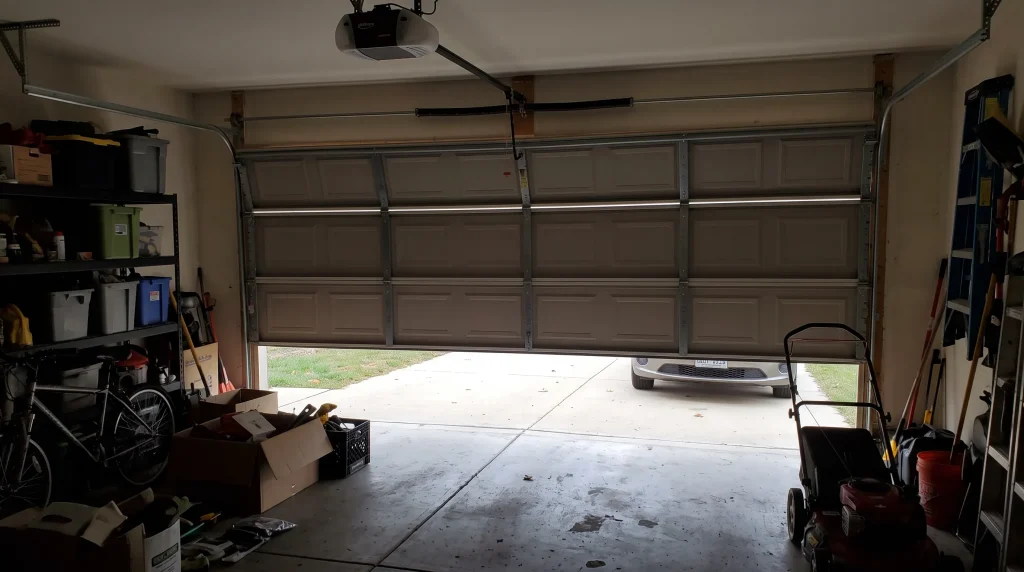
Symptom: The door stops at the same height, sometimes with a bump or a grinding noise, then reverses or holds.
Most likely cause: An object in the path or debris in the track. The usual culprits are a trash bin or bike leaning into the opening, a garden hose coiled at the base, a hardened ridge of ice and grit near the threshold, or gravel packed into the lower track.
Fix steps:
- Look down both vertical tracks with a flashlight for pebbles, packed grit, or a bent lip.
- Clear the floor across the full width of the opening, including the six inches nearest each jamb.
- Wipe the tracks clean with a dry rag. Do not grease the tracks, since grease collects the grit that caused the problem.
- Test the door.
Call a pro if: The track is clear and the door still stops at the same point. That moves you to a mechanical cause rather than an obstruction.
Why debris and road salt in the track make a garage door stop partway
Colorado Springs winters put a lot of magnesium chloride and sand on the road, and your tires carry it straight into the garage. It dries into a hard crust in the lower track that a roller cannot climb. If you treat your driveway yourself, it is worth knowing which products leave the most residue, and Michigan State University Extension’s breakdown of winter deicers compares them side by side. Sweeping the lower two feet of track once a month through winter prevents most of these calls.
2. A safety sensor beam is breaking partway down
Symptom: The door starts down, stops around waist or knee height, and reverses back up. The opener light may blink. Opening always works fine.
Most likely cause: The photo eyes near the floor lose alignment or get interrupted as the door passes. A sensor on a loose bracket can vibrate out of alignment during travel, which is why the door gets partway before the beam drops.
Fix steps:
- Watch the sensor LEDs while the door moves. If one flickers or goes out mid-travel, you have found it.
- Wipe both lenses with a dry cloth.
- Tighten the sensor brackets. A loose bracket is the difference between a sensor that works at rest and one that fails under vibration.
- Realign until both LEDs hold steady through a full cycle.
Call a pro if: Both LEDs stay solid and the door still reverses, or the sensor wire is pinched, stapled through, or chewed.
Why a garage door reverses halfway down instead of closing
Reversing is the opener obeying its safety system, not malfunctioning. Never tape over a sensor or hold the wall button to force the door past it. If your door is not moving at all rather than stopping partway, work through Why Is My Garage Door Stuck? 10 Common Causes (and How to Fix Them) instead, since a fully dead door points to a different set of failures.
3. Travel limits or force settings are out of adjustment
Symptom: The door stops at the identical spot every single time, with no noise, no reversal, and nothing visibly wrong.
Most likely cause: The travel limit tells the opener where to stop. The force setting tells it how much resistance to accept before assuming it hit something. Both drift with age, and both get thrown off when the door itself grows stiffer over the years.
Fix steps:
- Locate the limit and force controls on the motor housing. They are dials on older units and buttons on newer ones.
- Adjust the travel limit in small increments, testing a full cycle after each change.
- If you touched the force setting, retest the safety reverse. Lay a flat 2×4 on the floor under the door. The door must reverse on contact.
Call a pro if: You have to keep raising the force to get a complete cycle. That means the opener is compensating for a mechanical problem, and turning up the force hides the fault while wearing out the motor.
Why a garage door stops at the same spot every time
Consistency is the useful clue here. A door that fails at the identical height is following an instruction or hitting a fixed physical point. A door that fails at a random height is responding to something intermittent. If this only happens on freezing mornings and the door runs normally by afternoon, the cause is seasonal rather than electronic, and Why Is My Garage Door Frozen Shut? 6 Winter Causes and Safe Fixes covers what cold does to seals, grease, and metal.
4. A weak, stretched, or broken spring
Symptom: The door rises partway then stalls or creeps back down. It feels extremely heavy by hand. You may hear the opener straining.
Most likely cause: The torsion spring has lost tension or snapped. Springs carry the door’s weight, and the opener only guides it. A door that will not hold position at the halfway point has lost the counterbalance that keeps it there.
The test: With the door fully closed and the opener disengaged, lift the door by hand to waist height and let go. A balanced door stays roughly where you put it. A door that slams down or shoots up is out of balance.
What to do: Stop using the opener. Do not attempt the balance test if the door is currently stuck halfway and you cannot safely reach it.
Call a pro if: Always. Springs store hundreds of pounds of energy, and DASMA, the industry’s standards association, is direct about spring systems being for trained technicians only. This is routine broken garage door spring repair work and a trained tech handles it in under an hour.
Why a garage door with a bad spring gets stuck halfway open
A failing spring often shows up as a halfway problem before it shows up as a total failure. The opener has just enough power to lift the door part of the way, then the load exceeds what the motor will pull and it gives up. People often report a few weeks of the door “acting tired” before the spring breaks outright.
5. A bent track, damaged panel, or seized roller
Symptom: The door binds at one specific point, grinds, squeals, or shudders through the same few inches of travel every time.
Most likely cause: A dented track section narrows the path a roller has to pass. A creased or bowed panel pushes its rollers out of line. A dry roller with a flat spot drags instead of turning. Vehicle bumps and hail are the two sources we see most in Colorado Springs.
Fix steps:
- Run your eye down both tracks looking for dents, gaps at the seams, or loose lag bolts.
- Spin each roller by hand with the door closed. A roller that will not turn freely needs replacing.
- Lubricate rollers, hinges, and bearings with a garage-door-rated silicone or lithium spray. Never use WD-40 as a lubricant here, since it strips what is already there.
- Snug any obviously loose track brackets.
Call a pro if: A track section is bent, a hinge is cracked, or a panel is creased. Do not hammer a track back into shape, because it is formed to a specific radius and a hand-straightened section derails rollers at that spot forever after. A bowed section throws off every roller attached to it, which is why garage door panel replacement service is usually cheaper than the roller and track damage that follows if you leave it.
How to find the exact spot where a garage door binds in the track
Run the door slowly by hand with the opener disengaged and the door properly balanced. You will feel the tight spot long before you can see it. Mark it with tape and check the track, the roller, and the hinge at that height. Nine times out of ten the fault is at the mark.
6. A frayed cable slipping off the drum
Symptom: The door is stuck at an angle, one side sits lower than the other, or you can see slack steel cable bunched near the top of the track.
Most likely cause: The lift cable frayed and jumped its drum, or it snapped. Once one cable goes, the door immediately racks out of square and jams in the opening.
What to do: Nothing. Keep people and vehicles out from under the door and away from the opening. A door held by one cable is carrying uneven load on hardware that was not designed for it.
Call a pro if: Always, without exception. Proper garage door drum and cable service means rewinding the drum, matching cable length on both sides, and rebalancing the door, not simply threading in a replacement cable.
Why a garage door stuck at an angle is more urgent than one stuck level
A level door that stopped is inconvenient. A racked door is unstable. The rollers on the low side are being pulled toward the front of the track, which is exactly how doors come off the track entirely and fall inward. If your door is sitting crooked right now, that is the one scenario on this page where waiting is the wrong call.
7. Opener failure: stripped gear, chain slack, or thermal shutdown
Symptom: The motor runs but the door slows and stops, the chain slaps or sags, or the opener quits partway and works again an hour later.
Most likely cause: Three separate faults produce a similar result. A stripped plastic drive gear lets the motor spin without full travel. A loose chain or belt skips under load. A thermal overload cutout shuts the motor down after repeated attempts and resets once it cools.
Fix steps:
- Look for plastic shavings or grey dust on top of the opener or on the floor beneath it. That is a stripped gear, and it needs service.
- Check chain sag. Roughly half an inch of slack below the rail is normal on most units. More than that skips.
- If the opener quit after several attempts and later worked, that is thermal shutdown. It is a symptom, not the disease. Something is making the motor work too hard.
Call a pro if: You see gear shavings, the chain is visibly loose or jumping, or the unit keeps overheating. An opener that keeps thermally cutting out is telling you the door is too hard to move.
Why an opener quits partway and then works again later
Thermal cutouts protect the motor from burning out, which means the opener is doing its job. The mistake is treating the reset as a fix. Every cycle after that is running an already strained motor against whatever resistance triggered the shutdown in the first place, and openers that get treated this way tend to fail permanently within a season.
How to get a garage door stuck halfway down safely
This is the part that matters most, because more people get hurt dealing with a stuck door than by the original fault.
- Clear the opening. Get vehicles, pets, and children out from under the door and keep them out. Do not walk through the opening to save time.
- Stop using the opener. Two attempts is the limit. After that you are only adding damage.
- Check whether the door is level. If one side hangs lower, stop here and call a technician. Do not touch the release cord.
- Support the door before you release anything. With the door level and someone helping, place a stepladder or a sturdy prop under each side near the edges, not in the middle of a panel.
- Pull the emergency release only with the door supported. If the spring has failed, the door is unsupported weight and it will come down hard.
- Lower the door by hand using both hands on the bottom section edge, not the panel seams. Fingers in the seams is the most common garage door injury there is.
- Secure it down. If the door will not stay closed, clamp a pair of locking pliers onto the track just above a roller on each side so it cannot travel.
- Leave it closed until it is repaired. A door that failed once will fail again, usually at a worse moment.
If the release cord is the piece you are unsure about, How Do You Open a Stuck Garage Door Manually? 8 Steps Using the Emergency Release walks the full procedure, including how to re-engage the trolley afterward.
DIY-safe vs. call-a-pro: a quick reference
|
The cause |
Safe to try yourself |
Call a licensed tech |
|
Obstruction or debris in the track |
Yes. Clear the path, sweep the lower track |
If it still stops at the same point |
|
Sensor losing alignment mid-travel |
Yes. Clean lenses, tighten brackets, realign |
If LEDs are solid and it still reverses |
|
Travel limit or force settings |
Cautiously. Small steps, always retest the reverse |
If force has to keep increasing |
|
Dry or worn rollers |
Yes. Lubricate with a garage-door-rated spray |
If a roller will not spin or has a flat spot |
|
Weak or broken spring |
No. Never. |
Always |
|
Frayed or slipped cable |
No. Never. |
Always |
|
Bent track or creased panel |
Visual inspection only |
For any bent, cracked, or creased component |
|
Stripped opener gear |
Diagnosis only. Look for plastic shavings |
For gear or logic board replacement |
|
Door stuck at an angle |
No. Stay out of the opening. |
Immediately |
What to do next
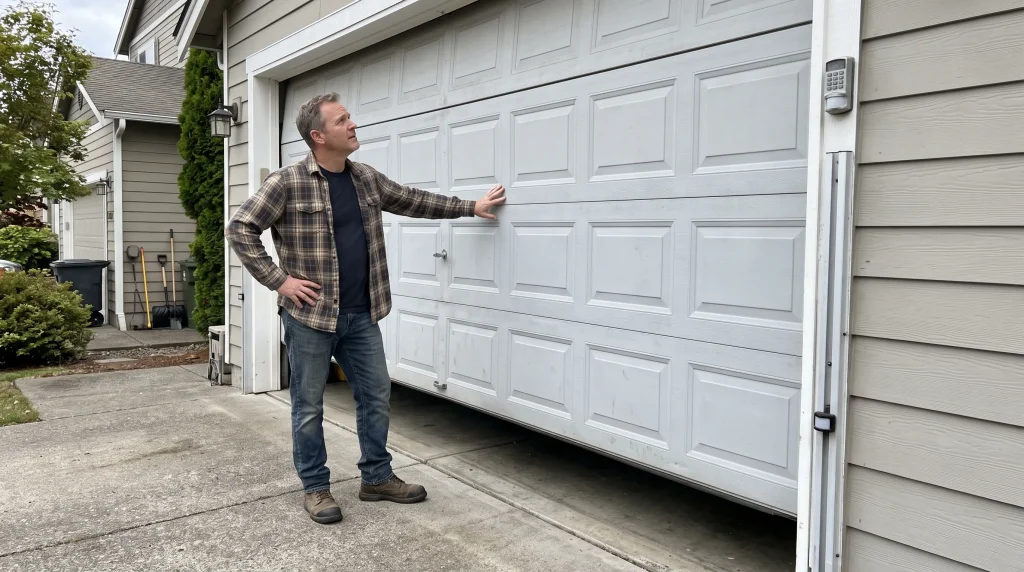
Start with the two free checks. Clear the track and watch the sensor LEDs through a full cycle. Those two account for a large share of halfway stops and cost nothing to rule out. If the door stops at the same height with a clear track, move to the limit settings. If it feels heavy, sits crooked, or grinds at one spot, stop troubleshooting and get eyes on it, because springs, cables, and off-track doors carry enough stored energy to cause serious injury.
If your door is hanging halfway right now and you are not sure it is safe to lower, Ascension Garage Door Service has licensed technicians across Colorado Springs with same-day availability for doors stuck open. Book garage door repair or request a free quote and we will get it closed and diagnosed properly.