


A quick garage door repair replaces the part that broke and leaves everything around it in place. The problem is that a garage door wears as a system. The components sitting next to the failed part have taken the same number of cycles, the same temperature swings and the same loads, so they are at the same point in their service life even though they still look intact. The eight parts below are the ones we most often find untouched after someone else’s visit: the second spring, the rollers, the cables and drums, the hinges and fasteners, the bearings, the bottom brackets, the safety sensor mounts and wiring, and the opener’s drive components. When a door fails again weeks after a repair, one of these is almost always the reason.
Key takeaways
- Garage door components wear as a matched set, not individually. Age and cycle count matter more than appearance.
- The second spring is the single most commonly skipped part on a two-spring door.
- Bearings and bottom brackets are the two parts homeowners never hear about and technicians most often leave alone.
- Several of these parts are under high tension. Springs, cables and bottom brackets are not homeowner territory under any circumstances.
- Colorado Springs conditions shorten the life of every part on this list, because temperature swings move metal and dry air strips lubricant faster.
- A door that has had two separate failures in a year has a component list that was never fully inspected.
1. The second spring on a two-spring door
When one spring breaks on a door that has two, the other one has taken exactly the same number of cycles. It has not failed yet, but it is at the same point in its life, and it is usually within months of going the same way. Replacing only the broken one is the fastest version of the job and the most common reason a homeowner sees a second spring call before the year is out.
There is also an immediate problem beyond the timing. A new spring and an aged spring do not deliver the same force, so the door lifts unevenly from the first cycle.
Why replacing one garage door spring leaves the other about to fail
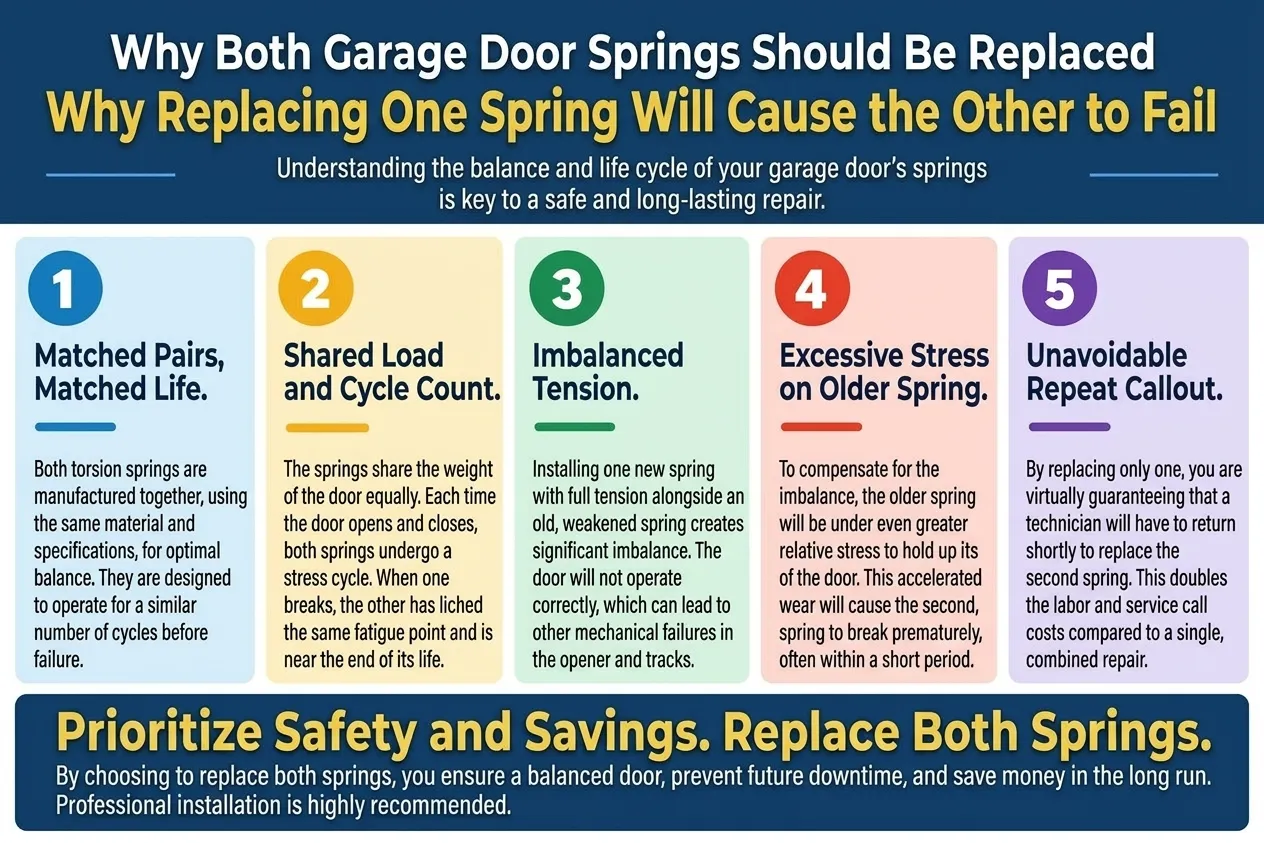
Springs are rated in cycles, and both springs on a door consume those cycles together. A spring near the end of its rating shows almost nothing externally, which is why “the other one looks fine” is a judgment based on the wrong evidence. The uneven lift that comes from mismatched springs also puts the door into a twist through its travel, which is covered in Why Is My Garage Door Crooked or Uneven After a Repair? 6 Causes (NOT YET PUBLISHED). For the signs that springs are approaching the end, see how to know if garage door springs need to be replaced.
Call a pro if: one spring was replaced and the other was not, regardless of how the door currently runs. Do not attempt to inspect or adjust springs yourself.
2. The rollers
Rollers are small, they are easy to overlook, and they carry the entire door. A roller with a flat spot, a seized bearing or play in its stem creates drag through every cycle, and that drag goes straight into the springs, the cables and the opener.
Rollers also arrive at the end of their life together, because they all turn the same number of times. Replacing two while leaving the other eight leaves the door running on worn parts.
Why worn garage door rollers fail soon after another repair
A roller that stops turning starts sliding, and sliding produces side load the stem was never designed to carry. The stem flexes, the roller tips, and the wheel begins riding the edge of the track channel rather than the center. That is the beginning of the sequence described in Why Does My Garage Door Keep Coming Off Track After Being Fixed? 7 Causes. Keeping the moving parts properly serviced slows all of it down, and how to lubricate a garage door covers what should and should not be treated.
Call a pro if: the door grinds, shudders or rattles through its travel, or a roller is visibly not turning as the door moves.
3. The cables and the drums
Cables are the parts that hold the door against the springs and keep both sides rising together. They wear from the bottom up, and they show it: fraying near the bottom bracket, rust, kinks, individual strands lifting away from the bundle. A repair that puts in a new spring and reuses aged cable has left the next failure sitting on the door.
The drums matter just as much. Both have to be wound so the cables carry equal tension through the full travel and seat correctly in their grooves.
Why old garage door cables fail after a spring is replaced
A new spring changes the forces the cables see. Cable that was holding up under the old tension can begin to unwind, jump its groove or fray under the new one. This is why cable failures so often follow spring work by a matter of weeks rather than being a coincidence. Our garage door cables and drums service covers both together for exactly this reason, and how often to replace garage door cables explains the normal service interval.
Call a pro if: you can see any fraying, a loose or hanging cable, or one side of the door leading the other on the way up. Stop using the door.
4. The hinges and the panel fasteners
Every cycle sends vibration through the hinges that join the panels and through the fasteners holding them. Over thousands of cycles, fasteners back out and hinge holes elongate. A technician with the door apart for any reason should be checking and retightening this hardware, and on a quick visit it is almost never touched.
Hinges are also where damage from a previous incident hides. Any event that pulled the door out of alignment put force through the hinges on the way.
Why loose garage door hinges lead to the next failure
A loose hinge lets a panel flex independently of the one above it. That flex changes the shape of the door right where the track curves, which is the point where the least amount of roller is engaged and where most doors come apart. It also concentrates stress on the panel itself, which is how a repairable door turns into a replaceable one. The wider consequences of leaving this alone are covered in the hidden risks of ignoring garage door wear and damage.
Call a pro if: you can see a bent or cracked hinge, a visible gap between a hinge and the panel, or a fastener backing out.
5. The bearings
Most homeowners have never heard of these, and that is part of why they get skipped. The torsion shaft runs through end bearing plates at each side and usually a center bearing at the spring anchor. They carry the shaft while it turns under full spring tension, and they wear out.
A failing bearing is one of the easiest problems to diagnose by ear and one of the easiest to ignore, because the door keeps working right up until it does not.
Why worn garage door bearings cause repeat failures after a spring repair
A bearing that has worn lets the shaft wobble rather than turn true. That wobble changes how the cable feeds onto the drum, which produces uneven winding, which puts the door out of level and loads one side harder than the other. It also grinds through the spring’s service life faster, so a new spring installed into a worn bearing does not last what it should. Replacing springs without replacing tired bearings is one of the clearest examples of the pattern behind Why Does My Garage Door Keep Breaking After It Was Repaired? 10 Reasons a Quick Fix Doesn’t Hold, the master guide this post belongs to. Our garage door springs work includes the shaft and bearing assembly rather than the spring alone.
Call a pro if: you hear a metallic squealing or grinding coming from the shaft above the door, or the shaft visibly moves up and down as the door runs.
6. The bottom brackets and cable attachment points
The bottom bracket at each lower corner is where the lift cable attaches to the door. It is under the full tension of the spring system whenever the door is closed, and it is the single most dangerous part on a garage door to disturb. It is also easy to ignore, because it is low, it is often behind the weather seal, and it rarely gets inspected.
Corrosion, impact damage and elongated fastener holes are all common here, particularly on doors where the bottom of the panel sits against a damp or heaving slab.
Why damaged garage door bottom brackets fail after other parts are replaced
The bracket does not fail gradually in a way you can watch. It holds until the metal around a fastener gives, and then that corner of the door releases under load. Any repair that increased spring tension or changed cable tension raised the force this bracket carries. This is the one part on the list we ask homeowners never to touch or remove a fastener from under any circumstances, because the stored energy releases instantly. For the picture of what a broken spring releases into this part of the assembly, see what happens when garage door springs break.
Call a pro if: you see rust, cracking, a deformed bracket or a loose fastener at either lower corner of the door. Do not attempt to tighten or remove anything there.
7. The safety sensor mounts and wiring
Sensors that keep dropping out of alignment are usually not bad sensors. They are sensors on a bracket that moves, or sensors connected by wiring that has been pinched, stapled through or pulled during another repair. A quick visit realigns them, the fault clears, and it returns within days.
The intermittent nature is the clue. A genuinely dead sensor stays dead.
Why garage door sensor brackets and wiring fail after a repair
Every cycle vibrates the track the sensors are mounted to. A bracket that is not solid moves a fraction each time, which is all it takes to break the beam. Damaged wiring behaves the same way for a different reason: a nearly severed conductor makes contact when the metal is cool and opens when it warms, which is why these faults follow the time of day rather than anything the homeowner is doing. Our post on why garage door sensor lights blink covers what the indicators are telling you.
Call a pro if: the sensors need realigning more than once, or the door reverses with nothing in the opening. A door that will not reverse on an obstruction is a safety failure and should be taken out of service.
8. The opener’s drive components
The opener is usually the last thing anyone inspects, because it is the part that is still working. What gets missed is that it has been absorbing the strain of whatever was wrong with the door, often for months before the visible failure. Gear assemblies wear, chains and belts stretch, rail hardware loosens, and the trolley and arm take the load of every hard cycle.
An opener that has been pulling an unbalanced door is not a healthy opener just because it still runs.
Why garage door opener drive components fail after the door is repaired
Force and travel settings are frequently increased to push a dragging door through its cycle, which means the drive components have been carrying more load than the design intended. Once the door is repaired properly, the worn gear or stretched chain remains, and it fails on its own schedule a few weeks later. A door that clicks but will not move is a common end point, covered in why a garage door opener clicks but does not open, and the parts of a garage door opener explains what each component does. Commercial operators have their own service path through our garage door opener repair team.
Call a pro if: the opener strains, grinds, runs without moving the door, or the door bounces at the floor.
What gets replaced compared to what fails next
|
Part that was replaced |
What routinely gets left alone |
What usually fails next |
|
One torsion spring |
The second spring, the bearings, the cables |
The second spring, often within months |
|
A cable |
The opposite cable, the drums, the bottom brackets |
The opposite cable, or uneven winding pulling the door out of level |
|
Two rollers |
The remaining rollers, the hinges |
Another roller, then the door leaving the track |
|
A hinge |
The surrounding fasteners, the panel edge |
Panel damage that cannot be repaired |
|
The opener |
The door balance it was fighting |
The new opener, on the same timeline as the old one |
|
Sensors |
The brackets and the wiring |
The same alignment fault returning within days |
|
Nothing, door reseated in the track |
Rollers, cables, hinges, brackets |
The door coming off track again |
The pattern in every row is the same. The replaced part is fine. The part next to it, carrying the same age and the same load, is what shows up on the next call.
What a complete inspection should cover
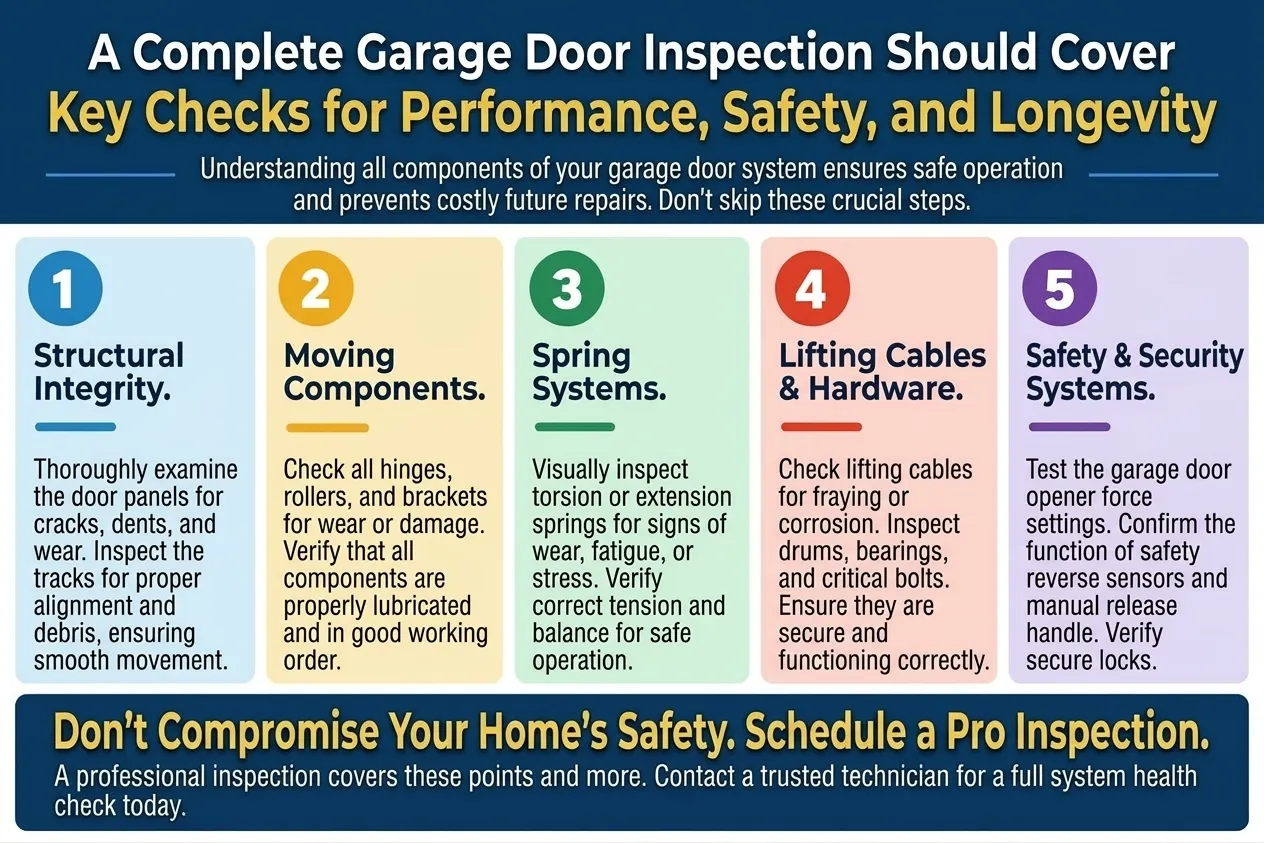
Rushed garage door work is a recognized problem industry-wide, not just locally. The trade association for the industry has been raising awareness about deceptive garage door service practices and maintains a public consumer resource page on garage door service scams. There is also manufacturer guidance on avoiding garage door repair scams describing what a legitimate service visit includes.
The common thread is documentation of the whole assembly rather than the single failed part. A complete visit covers springs, bearings, shaft, cables, drums, bottom brackets, rollers, hinges, fasteners, track condition, balance, opener settings and the safety reversal, and it ends with you being told which parts are near the end of their life even when those parts are not why you called.
The bottom line
A garage door repair that only replaces what broke is an incomplete repair, because the parts standing next to the broken one have the same age, the same cycle count and the same wear. The second spring, the rollers, the cables and drums, the hinges, the bearings, the bottom brackets, the sensor mounts and the opener drive components are the eight that get skipped most often, and they are the eight that turn one service call into three.
If your door has had more than one failure, Ascension Garage Door Service will inspect every component on the assembly and tell you honestly what is still serviceable and what is near the end, not just what failed today. We provide residential and commercial garage door repair and garage door service across Colorado Springs and El Paso County, plus garage door installation service when a door has reached the end of its life. Schedule your inspection and get same-day attention on a door that is unsafe to use.